Saturday, 19 of May of 2012

News

Healthcare and critical thinking

No Gravatar

My last post considered ways to think about the healthcare system and I offered five snippets addressing ways to think about the future of the health care system. The fourth of the five snippets was a simple statement to “think critically.” Easy to say; hard to do.

This is the first of eight posts that will take a deeper look at that simple piece of advice. Today I’ll provide an overview of seven components of critical thinking and in subsequent posts I’ll dig deeper into each of the components.

I’ve decided to focus on health care for a few reasons: (1) it’s REALLY important to a lot of people; (2) the “debate” has been highjacked by people (left and right) with very strong opinions who do not want us to actually think about healthcare, just follow their line of thought; and (3) I’m having a hard time getting my mental arms around this issue and feel that maybe a little writing will help me clarify my own position. I need your help here.

CRITICAL THINKING: It’s the process of figuring out what to believe and then what to do about your beliefs. It starts with “figuring out what to believe,” which takes time and is darn hard work. It’s easy to parrot a talk-show host; it’s uncomfortable to examine your own beliefs and figure out if they are built on a good foundation.

As you work on figuring out your beliefs, here are seven components of critical thinking to consider:  

  • What’s the ISSUE and how does the issue look from various points of view. From a moral perspective do you believe that everyone has a right to quality healthcare? From a fiscal perspective, who should pay for this right? For that matter, what about our individual responsibility to live a healthy lifestyle. Should I pay for your smoking habit and should you pay because I like to eat a lot? Paying for the system has come front and center, but it’s not the only issue. Step One of critical thinking: get clarity about the set of issues and work at prioritizing them.
  • What QUESTIONS bring clarity to the issues? And the most important question to ask is: Are we solving the real problems? With upwards of 90,000 people dying every year because of mistakes, misuses, and care-acquired illnesses, is the main issue about payment or quality? We have LOTS of smart people who can answer questions. Are we asking the right questions?
  • What CONCEPTS are we using to organize our thinking? I’ve had healthcare executives (angrily) tell me that “We are not a factory making widgets!” True. But the concept of standardization seems to work in every other industry. Might it be applied to some of the issues affecting healthcare? Concepts help us organize our thinking and then explain it to others. What’s your concept of a hospital? (Remember, in the late 1700’s they were literally “a place to go to die.”)
  • As we think about the health care system what are the ALTERNATIVES to today’s practices? The general hospital was right for medicine at the beginning of the 20th century because it did everything for anybody. A hundred years later is it still the right way to deal with injury and sickness? For that matter, what are the alternatives to staying healthy and never having to use a hospital?
  • ASSUMPTIONS are the foundation of all strategy and all plans. And when assumptions degrade, the plans are usually out of line with reality. What assumptions underpin the insurance industry? What assumptions are the foundation of the “medical home” concept being touted? What assumptions are employers making about their role in keeping employees healthy? What assumptions are you making about your health needs as you age?
  • “Truth” often depends on your POINT OF VIEW. What does the system look like from the point of view of a retiree who is in the Medicare system? What does the system look like from the point of view of the owner of a small business? What about a self-employed bloke like me? Who’s right? All of us. Who’s wrong? All of us.
  • As I write this all I know for sure is that Congress is going to do “something.” Not sure what it is; but I do know that whatever they do will have both intended and unintended CONSEQUENCES. People following an ideology tend to see the intended consequences of their actions and “get surprised” by the unintended consequences.  All of us should think about “what else” were getting when we take an action. It will play out – but later.

HELP!  I really want to get my arms around this and I need a conversation. Please comment – challenge – add-to – etc. Please pass this on to friends and colleagues who are in the system. What does it look like from the inside?

(Jodi, if you’re reading this it’s time to comment.)

OK, now it’s your turn.


3 comments

Healthcare, Uncertainty, and Thinking

No Gravatar

The healthcare system is fascinating because it will touch EVERYONE at one time or another. You may work in the system, or supply the system, or use the system – but it will touch you, one way or another, over the course of your life. I have friends who never fly and, therefore, don’t care about the airline industry. I have friends without cars who don’t care about the car industry. But I don’t have any friends who have never been sick or never needed medical help.  Healthcare is one of a few systems that touch all of us. So we had better think about its future.

Many people have written about healthcare as a “broken system.” I think of it as a rapidly evolving system that that is affected by a lot of strong forces, from technology to demographics to political posturing. In other words, the future of our healthcare system is uncertain.

How did we get here?  Well, the system that serves us today is the result of the predominant targets of the healthcare system in the past. Consider the role of doctors, nurses, and other healthcare professionals as they responded to the following:

  • 1850 to 1900: Epidemics are prevalent. Food, water, sanitation and other aspects of city life cause health problems for masses of people.
  • 1900 to World War I: Individual trauma (wounds) and infections are the focus
  • World War I to World War II: tuberculosis, malaria, pneumonia, venereal disease and industrial hygiene are big issues to be resolved in the United States.
  • World War II to 1980: We are living the “good life” and heart disease, cancer, and strokes are on the rise.
  • 1980 to Present: Chronic diseases, emotional and behavioral conditions, terror, war, and genetic inheritances come to the fore.

Now think about the next age of healthcare and consider the forces that will hit the system in the coming years: more and more people are uninsured or underinsured at exactly the same time as families have become smaller and more dispersed. The massive Boomer generation is aging. There are fewer people moving into healthcare. More and more healthcare has become a “for profit” business. The bottom line is that the system and its participants will be stressed in ways we have never precisely encountered before.

That said, this system has evolved in the past and is not a stranger to new ways.

The overriding challenge is for people affected by the system to think about its future and take appropriate actions. Doctor, administrator, nurse, patient, taxpayer – ALL have a stake in the future of this sytem.

The future of the healthcare system

Esteemed doctors, academics, economists, and consultants have written a great deal about their view of and prescription for healthcare and healthcare providers. However, much of it is built on a particular point of view and, when taken in total, a contradictory picture arises. Some see the future of healthcare providers operating in the context of a “consumer- driven” system. Some see the future of providers in the context of information-empowered “personalized medicine.” And others see the entire industry changing as we move (in their view) to a single-payer system. GE Healthcare sees a fundamental shift in the nature of the healthcare provider as the system moves from “late disease” to “early health.” Because all of these points view are about the future, all we know for sure is that no one is right and no one is wrong – yet. We are uncertain.

uncertainty

Healthcare is filled with smart and well-educated people. And that single fact is a cause for hope and concern as we face the future of this vital industry. Because we have so many smart people, we hope that we will be able to “figure it out” as the system changes. However, because we have so many well-educated people, we may be trapped into the viewing the evolving system through mental models that may no longer be appropriate.

As you reflect on the position you want to take in the current “debate” about the future of a system that affects all of us, I suggest that you might want to consider one or more of five ways of thinking.

  • Think about the speed of industry evolution. Our hospitals and providers have to keep up with the speed of evolution (on a global basis) or risk becoming irrelevant.
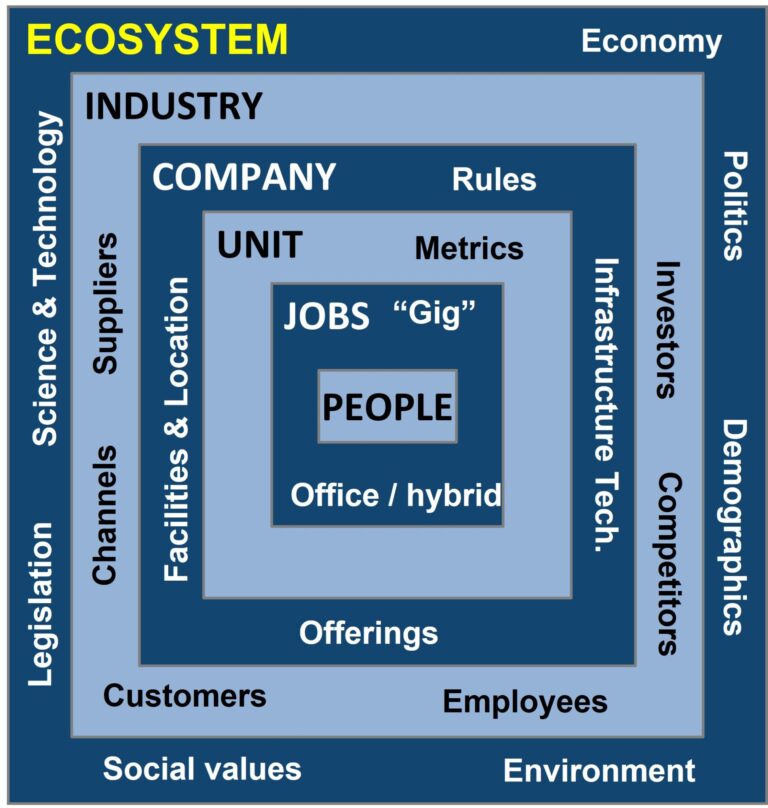
  • Think about the larger system. Our hospitals are part of a larger system and the answer to the question “Why is my hospital changing?” is always found in the larger systems of healthcare and economy.  
  • If you work in healthcare, think about your business model. Whether you are a solo practitioner or a team leader or the CEO of a hospital you have customers and they will the ultimate arbiters of your value.
  • Think critically. The world is loaded with people who have opinions. Are your opinions well founded on accepted principals of good thinking? Or, heaven forbid, are you simply repeating someone else’s opinions as “fact.”
  • Think across time. The past can inform actions we take in the present. All present day decisions have a “futurity,” both good and bad. And thinking about the future forms the visions we create for our organizations today.

When you think about OUR healthcare system do you throw your hands up in the air and say it’s too confusing? Don’t – your health depends on it.


15 comments

Uncertainty and Reasoned Risk

No Gravatar

You may not have noticed, but I took a week off. OK, maybe more. Went to the UK, rewrote my portion of a forthcoming book (I think you’ll like it). And I was just too tired to think. Been there? But I’m back.

I was browsing the books at my local Border’s shop and came across an interesting title, so I took my coffee and treated Border’s like a library. Anyway, the book (Inside the Mind of the Turtles) was written by Curtis Faith a former stock trader and he was writing about the mind of those people who make big bets every day. Interesting stuff.

uncertaintyI came across a section about managing risk and uncertainty – NOW he got my attention. His list of seven actions was nice advice and one of them (“take reasoned risks”) really caught my attention. How do you reason about uncertainty? I mean, it’s uncertain. Right? But the more I thought about it, the more I realized that instead of throwing our hands up in despair, we really do need to reason about risk during uncertain times. In fact, we need to do this more than ever.

Here are a few ways I think we might go about taking reasoned risks. I’d appreciate it if you would add to the list.

  • Think in terms of ranges instead of point estimates. (I’m a small business owner, revenue for 2010 won’t be as high as 2008, but it won’t be zero. I think it’s reasonable to assume a budget built on falling into a 60 -80% of 2008 revenue. Now I can go by some equipment rather than wait for “the recovery.”)
  • Learn from others. How are my competitors handling this uncertainty? What about companies in other industries? What about historical analogs?
  • Focus on the future, not the past. My sales in 2008 are an interesting, but historical, data point. Who will need my services in 2010? What changes will my clients be dealing with? What trends will continue and what trends cannot continue? (Side Note: It seems to me that in 2007 and 2008 the entire building and mortgage industry assumed that housing values would escalate FOREVER. Didn’t you just know that trend had to abate?)
  • Study the pressures for change affecting your industry and your customers’ industry. Which pressures might bring gentle change? Which pressures might trigger breakpoints?

By the way, I’ll tell you the other six actions if someone asks me. That way I’ll know that at least one person read this post.

Bye for now. Don’t forget to add to my list. How do you go about taking “reasoned” risks?


7 comments

Uncertainty and the need for new role models

No Gravatar

uncertaintyWho is your role model? Or, more importantly, who are your role models in these uncertain times?

Wow, just think back to the good old days (the roaring 90s) when all we had to do was pick up another book about Jack Welch and apply “the GE way” to all of our problems.

Who now? Who can we use when things are so uncertain?

How about great explorers? Try Roald Amundsen. He was the Norwegian explorer who was the first to reach the South Pole on December 14, 1911. There was a lot of uncertainty about the terrain and the conditions he and his team would face. So he focused on some things that remained true and important no matter what – weight and warmth. For example, while waiting for the “good” weather he spent time shaving down the sleds and wooden boxes to get them as light as possible. He also spent time tending the sled dogs who would carry him to the pole. Think about your business. What DO you know during these uncertain times? You obviously know you have to keep costs under control. Do you also know that you will need new and better talent? Should you get rid of people to reduce costs or should you take this “downtime” to improve the capabilities of your team? Think like an explorer.

How about great detectives from our fictional past, the heroes of our who-done-its. We’ve all read about Sherlock Holmes but I prefer to think a bit more recent and consider the fictional Nero Wolfe. No action hero here – he’s big and fat. But he certainly sees the clues that others miss and comes up with unique ways to solve the crime. What are the clues that you need to connect to make some sense out of uncertainty? What scenarios could you construct and put into mental competition as you plan for the future. Think like a detective.

How about great scientists? Thomas Edison had great drive and a willingness to experiment and, most importantly, to use failures to rebuild and rerun experiments. He failed in the quest for a light bulb thousands of times as he dealt with uncertain properties of materials and how they would react with electric current. He also thought BIG – the light bulb was part of the electric system he had conceived. Scientists take it for granted that experimentation and failure are part of their daily life. Too many business people hold off until they are sure something is going to work. Maybe you should think like a scientist?

So, here are some of my role models during uncertain times. Who do you look to for guidance and inspiration?


6 comments

A Prepared Mind — can reason

No Gravatar

ATTENTION! ATTENTION PLEASE!

Please excuse me while I get up on my metaphorical soapbox and have a short rant.

We are becoming intellectually lazy and losing our ability to reason!! 50% of American households buy a newspaper today while over 100% bought a newspaper in 1950! (Over 100% because we had morning and evening editions then.)

OK, I’m down from the soapbox and I have a question for you. Is the above conclusion a good conclusion? Or am I simply A CRABBY OLD MAN ranting about the “younger generation?”

Not sure? Here, try this one instead. “People who drink green tea show a lower incidence of heart disease. Therefore, drinking green tea reduces the risk of heart disease.”

OK, maybe I am a crabby old man, but both examples show bad reasoning.

In the first instance I used emotion (bold type and double exclamation points) and then gave you an unrelated fact to “back up” my statement. Hmmm, do you ever see that kind of “reasoning” coming from our politicians, or talk-show hosts? Maybe in the current healthcare “debate?” In the second example I gave you a conclusion based on a related fact – but a fact that only showed correlation, not a cause.

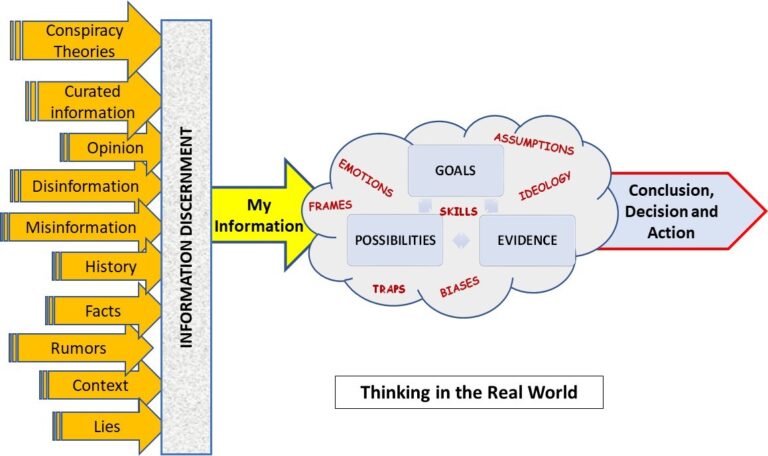
If you want to be prepared for the future you have to reason well and good reasoning requires that we challenge the “facts” and assumptions that underlie our thinking. Good reasoning is informed through ongoing learning; and new data comes through the skill of observing. Finally, we test our reasoning and the results of our decisions when we reflect.

But let’s get back to the rant of intellectual laziness. (I like ranting, it comes with age.) Good thinking requires that we use evidence to support our conclusions. So here is my Prepared Mind question of the day: Where do you get your evidence for the decisions and actions that guide you and your daily life? Do you take the time to educate your thinking process? Are you willing to plow though a fifteen page article in Atlantic Monthly magazine or do you pick-up your “factoids” from USA Today? By the way, newspaper readership is down significantly, so where are we getting “the news.” And, for that matter, how much of the news on TV or the web or radio is really important news?

Reasoning is hard work and it takes time; so, sometimes, we get a bit lazy and let others do our reasoning for us. Or, we let opinions substitute for reasoning. And, more often than not, we form our opinions based on “received knowledge.” That is, we let others tell us what to think. We see this all the time in people who are devoted to a political or religious ideology. (Does Rush Limbaugh or (now Senator) Al Franken do your thinking for you?) When this happens we fall into the traps of never looking for disconfirming information or not considering other points of view.

Going back to my opening rant, I really do believe that we are becoming intellectually lazy. And I mean ALL of us, not just the younger generation. That’s my opinion and I’m sticking to it. Now it’s your job to prove me wrong. You can give me your opinion (which I’ll ignore because it does not support my opinion.) Or you can reason with me. It’s your choice.

Come on – REASON with me!!!!!


5 comments